 |
Worlds leading producer of new equipment and OEM parts for |
 Made in the USA |
| Products > Kimwood Sanders > Crossbelt | ||
|
Kimwood Machinery Inc. offers the STATE-OF-THE-ART in wide-belt sanders. Kimwood's impressive history of successful installations has made Kimwood sanders the standard from which many others are judged. Dating back to 1960, the basic design philosophy for all Kimwood equipment continues today.... a heavy duty machine capable of combining high production while producing the finest sanded panels in the industry. Our ongoing policy has been one of product and service commitment to the forest products industry. Click the following link to check for "New or Reconditioned Equipment" currently in stock. | |
|
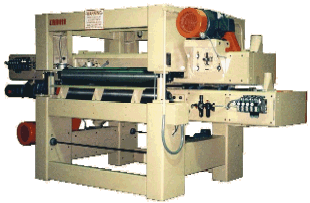
With the increased demand for finer finishes and the adding of additional sanding heads to the primary sander to achieve this finer finish, problems with streaks, raised nap and surface imperfections started to appear on the panel surfaces. To support the industry, Kimwood developed the Crossbelt Sander in 1995. With the introduction of the Crossbelt, producers of particle board and MDF board now have a way to produce panels with a highly polished finish. The Crossbelt was designed to eliminate these surface imperfections and to provide a smooth polished finish by changing the appearance of the abrasive belt scratch pattern. The emphasis is simply on polishing with less than .001" generally removed from the panel surface. Hence it is not intended to remove stock or to provide panel dimensioning. Typically a 150-grit belt will provide a final polish of 180-grit. Customers claim the surface imperfections are minimized if not totally eliminated with the Crossbelt. |
|
The Kimwood High Speed Crossbelt Sander is furnished in multiple widths ranging from 4' to 10'-6" wide and feed speeds up to 200 ft/min. The platen bar has a triple adjustment feature, consisting of a thick or thin platen height fine adjustment, platen tilt adjustment and center adjustment (7' to 10'-6") which allows for correcting concave or convex sanding. |
 |
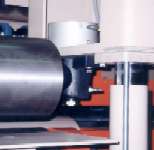 |
There are two air loaded smooth steel pinch rolls and two bottom smooth steel driven feed rolls with one set on each side of the cross belt to feed and stabilize the panel. The bottom feed rolls are driven by a A.C Variable Frequency Drive unit with a top speed of 200 ft/min. |
Retrofits:Kimwood has been involved in the manufacture of sanders for the wood products industry since 1963. Through the years, the sanders have continually been updated to accomodate specific industry applications which characterize the everchanging industry. As the applications have changed so have certain areas of the sanders. In some cases, Kimwood has introduced new models to meet new applications or modified existing models simply to remain competitive in the industry. Irregardless, Kimwood sanders remain the leading sander in the industry today. Click "Sander Retrofits" for available sander upgrades. Roll Inventory Program:The Roll Inventory Program was introduced in September of 1999 when Kimwood began stocking rolls that were in the highest demand. Kimwood has now implemented a revised program that will increase the number and type of rolls held in inventory via component stocking rather than assembled rolls. Component stocking will allow more individual roll parts to be placed in inventory which are used on multiple roll assemblies. This will be advantageous and will increase our ability to meet the high demand rolls needed to help customers during downtime situations. Click "Roll Inventory Program" for more information. Parts, Manuals, & Assembly Drawings:Kimwood maintains historical files for all of it products lines. As a result of this, almost all of the equipment originally supplied can be manufactured from our files. Kimwood also can reproduce most machine assembly drawings and original manuals for those pieces of equipment. Click "Parts, Manuals, & Assembly Drawings" for more information. Sander Trade-in / Reconditioning Program:The Kimwood Crossbelt is a relatively new sander to the industry. In this regard there is no active rotating rebuild / replacement program in place. This does not mean Kimwood would not entertain a request to rebuild all or a part of a Crossbelt or, take an older Crossbelt in on trade against a new purchase. We would ask that you contact the Kimwood sales department directly for rebuilding / replacement information. | |
Kimwood Machinery Inc. |
77684 Hwy 99 South |